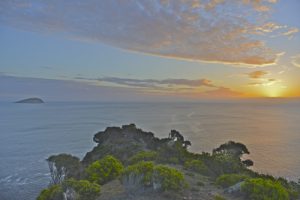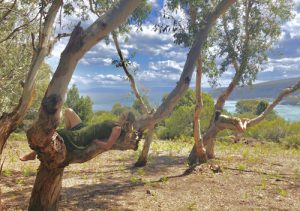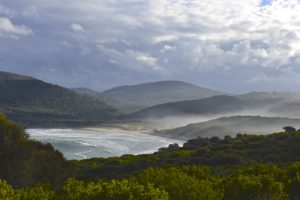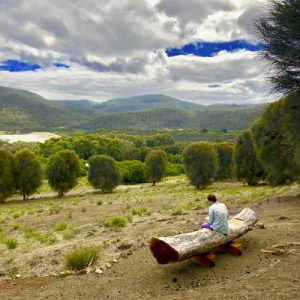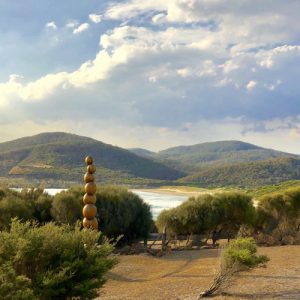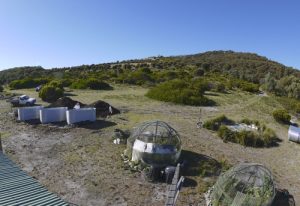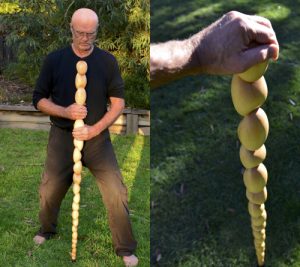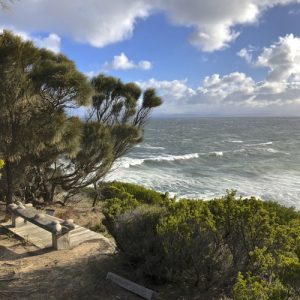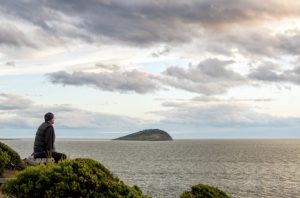
I converse often on the land here at Windgrove although my daily conversations tend not to be in English; rather, a non-verbal, felt communion with echidnas, wombats, wallabies, eagles and the occasional whale (one seen four days ago). Aren’t we all such strange and wildly beautiful animals, even if a bit batty?

Speaking of which, David Abram’s new book ‘Becoming Animal: An Earthly Cosmology’ has just been released. From his publisher:

The shape-shifting of ravens, the erotic nature of gravity, the eloquence of thunder, the pleasures of being edible: all have their place in Abram’s investigation. He shows that from the awakened perspective of the human animal, awareness (or mind) is not an exclusive possession of our species, but a lucid quality of the biosphere itself—a quality in which we, along with the oaks and the spiders, steadily participate.

Sitting in their Santa Fe home garden is David Abram and partner Carmen who I visited two months ago. I miss them and our lively discussions on love, gardening, more love, the earth, even more love, the human animal, and, did I forget to mention, a little more talk of love?

To be honest, since returning from my three months of global travels, I have to admit to missing the buzz of being surrounded 24/7 by likable people of mutual respect who carry a love for the earth in their hearts. Not to say that my neighbours here don’t, because they do, it’s just that when travelling I become addicted to the “daily” intense discussions one can have at Schumacher or Esalen or Tassajara or Sprit Rock or Harbin Hot Springs or any number of Berkeley cafes. Here at Windgrove, though, the frequency of human dialogue is far less and its been hard to “slow down” even though my meditative practice asks for this.

And so I am in the process of re-learning why I live where I do and submitting to the conditions my life and my life’s teachings have dealt me. Most of the time this is a smooth, easy re-entry like putting on a well worn glove. Sometimes, though, this submission brings forth an uneasy anxiety, as when I get an email from Thomas Moore and his wife Hari Kirin that reads in part: “we both profoundly appreciate your life and work”.

Make no mistake, a real gratitude for their appreciative words does fill my heart, but a sad, old wound also gets pricked.

“Great”, I moan, “but you two have each other, and David Abram has a partner, and so does Fritjof Capra. Where is my love? Where is the intimacy in my life?”

When this wound opens, I question the worth of what others see as my “profound life and work” and wonder whether or not a simple house with a white picket fence and a loving wife (maybe, even two little kids) would have been a whole lot easier.

Yet….. even as I speak these words, I also know that the black dog of loneliness that “occasionally” stalks me at Windgrove (and I want to emphasize occasionally) is one of the many teachers that have pushed me into awareness. For in truth, I could not be the good teacher I am in England and America if not for the challenges faced at Windgrove where I have chosen, and deliberately so, to live a life on the edge.

This morning, in supposedly cold Tasmania, I photographed my Windgrove home where moments earlier I had basked shirtless on the deck in the soft heat of a winter’s sun. Later, hand weeding my small garden, dark hands loosened and released the composting soil back onto the earth so that it could do its work.

Like a Holy Face

Only as a child am I awake
and able to trusty
that in every fear and every night
I will behold you again.

However often I get lost,
however far my thinking strays,
I know you will be here, right here,
untouched by time.

To me it is as if I were at once
infant, boy, man and more.
I feel that only as it circles
is abundance found.

I thank you, deep power
that works me ever more lightly
in ways I can’t make out.
The day’s labor grows simple now,
and like a holy face
held in my dark hands.

The Book of Hours I, 62
translation — Joanna Macy & Anita Barrows

{ 0 comments }

Just a month ago I spent six quiet days at the Tassajara Zen Mountain Center in northern California — the oldest Japanese Buddhist Soto Zen monastery in the United States.

Meditating twice daily in the zendo with the monks and nuns while also quietly soaking in their hot spring tubs and gratefully dining on their world famous cuisine, it was relatively easy to drop one’s personal and global anxieties behind.

(Concerning the thoughtfully prepared vegetarian food, intriguingly, the traditional name, ‘Tassajara’, is from an indigenous word which means “place where meat is hung to dry”.)

I was surrounded by peace and rest.

My mind didn’t race.
My thoughts didn’t fly high.
My body slowed down.
.
.

This Press of Time

We set the pace.
But this press of time –
take it as a little thing
next to what endures.

All this hurrying
soon will be over.
Only when we tarry
do we touch the holy.

Young ones, don’t waste your courage
racing so fast,
flying so high.

See how all things are at rest –
darkness and morning light,
blossom and book.

Rilke, Sonnets to Orpheus I, 22
(translation: Joanna Macy & Anita Barrows)

This poem comes from the newly published book “A Year with Rilke” and is the daily poem for today’s date: August 25. I find its message continually important; even more so despite not being a “young one”.

In the river below the Tassajara hot tubs, the three stacked rocks were done one contemplative morning and they suggest to me what Rilke was writing about. The stone figure has hands in pockets, silently enduring, eternally pondering the age old question of whether or not one can step into the same river twice.

Now that I’m not in such a conducive meditative “environment” as Tassajara, I have to look elsewhere for the quieting of my restless soul. And that elsewhere, for the moment at least, can only be Windgrove.

My grey haired webmaster Allan Moult, standing on The Point, could be doing Chi Gung as he quietly tarries — touching the invisible holy?

And my shadow? It seems up in arms — either in celebration or frustration. You choose. But to me, certainly the former. Or, I would hope so. If I need a confirmation that my life is on a decent path (and, yes, occasionally I do need a supporting loving hug), I can go to the inscription Joanna Macy wrote for me in ‘A Year with Rilke’:

“For Bear — in gladness for your life at Roaring Beach and around the world, kindling love and reverence for Earth!”

{ 0 comments }

Practicing what was learned

August 18, 2010

Last week I was swimming in the warm waters of Hawaii where palm patterns caught my attention. Today I am back in wintry, yet sunny, Tasmania trying to settle into a more “normal” daily routine than the coffee/Danish pastry/coffee one I “suffered” through for three months while whirling into and out of England and America.

Details will emerge over the next few blog entries, but for now, it seems worthwhile to juxtapose a few pics of the hands on gardening workshop I took at the Esalen Institute (along the Big Sur coastline in California) with photos of the tiny Windgrove garden taken just yesterday where I planted out seedlings of broccoli, cauliflower, spring onions and corn lettuce in one of the two “dome enclosed” garden beds.

The Esalen veggie garden feeds over 300 people per day. My attempt at a garden feeds no one just yet, except, of course, if nourishing the weary traveler’s soul by digging dirt is considered food. Nothing like dirty fingernails to sooth the disquieted soul suffering from separation anxiety; my separation from the daily chatty encounters with the many inspired people I met along the global path.

And if I have learned anything, it is that a very physical connection to earth is a prerequisite for sanity.

Another comparison worth making is between Esalen’s and Windgrove’s bathing facilities. On the one hand, the Big Sur’s Pacific coastline makes a dramatic background for the excellent hot tubs one can immerse into at Esalen (along with 3 or 4 others in each of around 9 tubs of various sizes).

On the other hand, the smaller Windgrove tub might only hold two people, but privacy is guaranteed.

I’m back among the dancing trees I call home.

{ 2 comments }

A path into the heart

February 14, 2010

Today is Valentine’s Day. A day when the heart speaks, should speak, of felt love.

And not just of the personal — the love that flows between two people — but also, even more importantly, the throbbing intensity that should be felt between all people and the earth.

Over and over again I keep coming back to the question: “How shall we love before we have lost everything?”  

Embedded in this question are the multiple questions I daily ask of myself: “How shall I love myself before I have lost everything? How shall I love others before I have lost everything? How shall I love this earth before I have lost everything?

The same can be asked of you. “How can you love before you have lost everything?”

The same can be asked plurally of us: “How shall we, as a society of humans, love each other and this earth before we have lost everything?”

Somewhere in the above mosaic of two photos is the answer.

In the foreground there is a path. A path we have to all walk faithfully to reach the blood red posts of the temple. A temple housing a simple wisdom of moon and stars painted on stones; stones brought by each of us up our life’s path; stones that themselves were shaped by countless eons of tidal flows.

The temple (built by artist Sally Horne) is a combination of skill, aesthetics, emotional outpouring and spiritual presence. It rests in the sensual body of nature. The two go hand-in-hand. There is not the one without the other.

Love comes quietly
finally
Drops around me
on me
in the old way.

What did I know
thinking myself
able
to go alone
all the way.

Robert Creeley

“The old way” is the way of the goddess. The divine She.

She, whose heart pulses through her body the Earth, awaits our love.

We cannot ever reach the temple alone.

{ 3 comments }

Rust in peace

January 29, 2010

Is this trash? Does it mar the landscape?

After having each served a nine month stint as a cover for the Peace Fire during the six years from 2002 till 2008 these ten galvanized, circular lids now lay with their backs to the ground for a final sleep until their slow dissolve back into the earth.

Rust — a reddish iron oxide formed by the reaction of iron and oxygen in the presence of water or air moisture and helped along at Windgrove by a sprinkle of sea salt.

Lovely patina. Rather “rustic”.

The fire pit that these lids both protected from rain and wind as well slowing down the combustion rate of the burning logs now sits empty. However, there is something in the remnant fiery afterglow of today’s dormant lids that never fails to rekindle in my mind the many months of daily tending to the Peace Fire and nurturing it along with some 60 tons of firewood.

Instruction from Bly

…….I consider
The Smirnoff bottle on the coffee table; a fly
Lands on it. And then it all happens: the life
Of that bottle flashes before me. Little by little.
Or quickly, it is used up; empty, as clear as it was
Full, it journeys to the dump: it rests upon the mounds of
Beautiful excess where what we are –
Sunflowers, grass, sand –
Is joined to what we make –
Cans, tires and it itself in every form of bottle.
I put on my s.s. coveralls, a saffron robe, knowing I have found
What I was sent to find. The sky speaks to me; the sound
Of the cars on Highway 2 is a song. Soon I will see the pumps.
Those curved rectangles shaped like the U.S. and smell the gas.
Our incense. O country, O moon, O stars,
O american rhyme is yours is mine is ours.

(author unknown)

Notwithstanding the reference to America, I like the notion that the world is one interconnected, chaotic, jumble of material objects. What’s the difference between a vodka bottle and a fly? A rusting lid or decaying log? Does location make a difference? Is one object inherently more beautiful/ugly than the other?

A tree discards a leaf or two. Is this litter? A human discards a can or two. Is this litter? Considering that the origin of “litter” comes from “bed”, the tree is literally littering.

Not that I’m in favour of trashing the landscape, but trash found in the landscape just might offer us an insight into what “ephemeral” might mean in a “natural” setting. My Shakespeare Bench certainly did.

More than anything, though, the rusting lids offer us a chance to reflect upon our own ultimate return to dust.

{ 0 comments }

Mix sun, water and oil

January 19, 2010

Leonardo da Vinci is widely known as an artist and not so well known as a scientist. He was equally both. And what informed both his art and science was a keen observation of nature and its many interconnections. One could even say that Leonardo was an early advocate of a systemic, interdisciplinary approach to understanding the world around him.

Because I will be co-teaching a course on Leonardo this coming May with physicist and systems theorist Fritjof Capra — where I take the role of Leonardo the artist and Fritjof that of Leonardo the scientist — I have been preparing myself by trying to be as deeply observant of nature as Leonardo would have been in his daily walks around Florence, Milan or elsewhere in Italy. Not that I haven’t been doing this regularly in my life here at Windgrove, but the focus is a bit sharper; a bit more curious as to the physics and creativity behind the events.

Last week I had a problem. There was mosquito larvae in the large Balinese water bowl. So, like a scientist, I scratched my head and remembered that a custom in outback farms in Australia was to put kerosene into water tanks to stop the mosquito larvae from growing. It wasn’t because the kero acted as a poison, rather, because oil floats on water, the larvae couldn’t break through it to get a breath of air.

Like Leonardo, who was always improving on previous past solutions, I reasoned that since it was the “oil” aspect that killed the larva a better solution would be to use something not petroleum based and bad for the environment. Therefore, I chose olive oil.

I poured a bit into the water bowl and lo, and behold, my artist self was amazed at the wonderous light show that bubbled up as the oil separated into little droplets and floated to the surface.

My scientist self was intrigued at how the sun’s rays were being dispersed as they passed through each individual drop of oil and focused to a point behind the drop. Would oils of different viscosities give different results? And how did the length of the cone relate to the diameter of the droplet?

“Too beautiful!” stated the artist. “Like little trumpets”.

“Add some more oil.” pleaded the scientist.

“Hark, the herald angels sing.” blurted the artist as I conjured up a whole host of heavenly angels trumpeting the praises of the beauty of this earth.

“Did you kill the little buggers?” asked the morally neutral scientist waiting for a positive response to the experiment.

“Awesome. Just fucking awesome.” they both said.

{ 2 comments }

A cautionary tale

January 12, 2010

Inertia results, not so much in the delay of the future, but in the destruction of its potential. For a very long time I was aware that the Shakespeare Bench was slowly degrading and that if I wanted its carved-into-the-wood message of “tongues in trees, sermons in stones, books in brooks” to have a longer [...]

Read the full article →

A 2nd life

January 4, 2010

Jerry Michalski has been coming to Windgrove off and on for a month doing sketches, preparatory small paintings and now, today, a larger, final oil painting of Roaring Beach. Generally, his routine is to awake at 6AM, observe the light on the beach, take notes and then meet me for morning coffee and toast around [...]

Read the full article →

A Christmas gift

December 30, 2009

My replication of Goldsworthy’s “sticks-in-the-air” is in celebration of finally having some 500 plastic bags and 2000 bamboo sticks removed from trees near the Peace Garden Pond. Trees that formed the bottom portion of a gigantic keyhole symbol (if viewed from the air). To do this required the generous international cooperation of people born in [...]

Read the full article →

Merry bathing

December 23, 2009

Just in time for summer solstice ablutions my neighbour Steve and I moved a 600 pound carved Balinese water bowl into position in the far corner of the bath area and then spent the rest of the day hauling in top soil and pine bark and planting out 18 prostrate juniper bushes. Even though these [...]

Read the full article →